

Evidence-Based Story Assessment: Redefining How We Value Growth in Learning
What changes when students become the storytellers of their own learning?
Courtney is an international educator with 23 years’ experience and currently serves as High School Curriculum Coordinator at The American School in Japan. She leads transdisciplinary, experiential learning that prioritises student inquiry and agency, and is deeply committed to addressing the hidden power imbalances of traditional grading. Courtney advocates for assessment that empowers learners and uses evidence-based storytelling to make learning visible, growth-focused and human-centred.
When finishing a year of learning, students should celebrate learning and growth, and yet collapsing their work into a single letter grade tells little of either. I’m proud of how our school has embraced deep learning and the six global competencies, yet as the year ended, too many students questioned the fairness of their grades and how they were being quantified. It left me wondering how schools can better center what we truly value. The answer, I believe, lies in changing how we assess learning.
A mentor once told me, “The person doing the talking is doing the learning.” That phrase has stayed with me and defines my understanding of learning. When students articulate their learning, they move from being recipients of education to active participants in constructing it. As such, students having a “voice” in their experiences is not actually a result that they have learned something, but the evidence of it. When students tell the story of their learning, they make meaning from their growth through active thinking, dialogue, and individual voice.
When teachers are the only ones gathering evidence and identifying learning patterns, students miss the chance to understand themselves as learners. Assessment should help them recognize what they are learning and which strategies work best for them. When students translate their learning journey into meaning, school becomes less about grades and more about self-understanding. Story-based assessment provides a human, self-directed approach that mirrors how the brain learns, combining knowledge with emotion and purpose.
What Is an Evidence-Based Story and Why It Matters
The National Institute for Learning Outcomes (2025) defines assessment as the process of arriving at inferences or judgments about learner proficiency based on a set of observations. When determining grades, teachers make claims about students’ knowledge, skills, and abilities using evidence from what students say, do, or make to infer what they know or can do. Traditionally, schools have asked teachers to be responsible for this process, which is why, as educators, we can quickly make judgments about performance and identify strengths and weaknesses. By evaluating student work, looking for trends, and recommending next steps, we strengthen our abilities, but the students’ ability to assess their own learning does not grow.
According to Natasha Jankowski (2021), evidence-based storytelling is the practice of transforming assessment data into narrative meaning, linking evidence, interpretation, and action so that feedback informs better decisions rather than compliance.
This approach requires students to explain what they’ve learned, how they learned it, why it matters, what problems they encountered, and what strategies they used to overcome them. When reflection and evidence meet, assessment transforms from a record of performance that a single teacher has determined to a narrative of growth a student unfolds into a sense of self. It is clear that students should serve as definitive sources of formative assessment because they have constant access to their own thoughts, actions, and work. When they are taught to reflect on their progress, set goals, and monitor their learning, they begin to develop the evaluative skills necessary to interpret their own evidence. In this way, evidence-based storytelling is not new; it is a well-researched practice that becomes powerful when integrated into daily classroom assessment (Andrade, 2010).
An evidence-based story consists of a collection of evidence of the learning process, which becomes the foundation for explaining a student’s learning journey. Depending on the scope and time frame, the evidence might range from a single exit ticket at the end of a lesson to a collection of formative, summative, or reflective evidence from different subject areas. In international classrooms, students bring a variety of languages, cultures, and ways of knowing to their learning, and allowing them to share how the evidence of their learning blends with their unique diversity helps them see themselves in their journey. The real benefit of allowing students time and space to tell their whole story is that it gives educators a fuller picture of student progress (Vardabasso, 2025). When students construct their learning stories, they are not only explaining what they did but identifying patterns, shifts, and insights that might otherwise remain unseen. In schools that value reflection, students begin to see evidence not as proof of achievement but as a source of insight. They start to ask: What helped me learn this? What patterns do I notice? What am I proud of, and where am I still uncertain? These questions make reflection a natural part of the learning cycle.
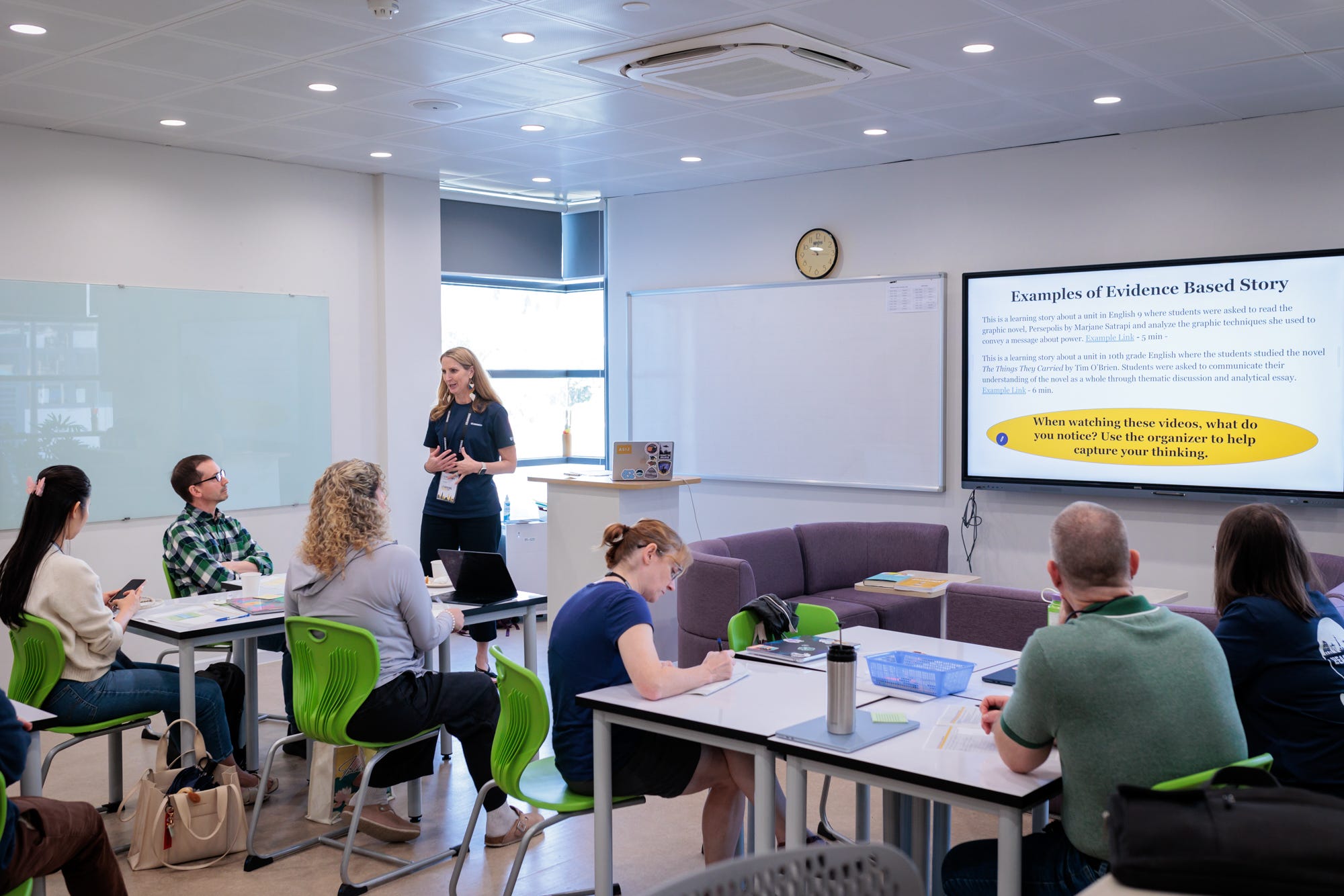
In our Grade 9 English team, we saw this unfold when we adapted a unit that focused on the concept of power through Satrapi’s graphic novel Persepolis. Throughout the unit, students kept a power journal, annotated their books, recorded discussions, saved feedback, and wrote short reflections that connected ideas in English to other classes and to their own lived experiences. At the end of the unit, we asked them to tell the story of their learning and supported their work by giving them storytelling frames to guide their thinking. The stories they told focused on their experiences with the learning as individuals and uncovered the moments when something shifted or improved their thinking. Sometimes it was a piece of feedback, an exercise or a lesson. Other times, it was a family member or friend, a co-curricular activity, or an experience in another class.
We found that each story was different, even though the learning design was the same. The most powerful evidence-based stories were both personal and analytical in nature. They demonstrate how a student’s voice is connected to their evidence of learning and often described how the project strengthened their collaboration skills or how revising an essay deepened their understanding of audience and tone. These reflections were not polished and perfect, but required an honest accounting of how learning changed thinking. After telling their stories, students reported feeling seen and included, and we learned more about their thinking than any single essay could show.
When grading these assessments, initially, we were concerned about subjectivity; however, our team leaned into our collective strengths as professionals. Of course, there was some subjectivity; there always is in grading. What was needed was a shared understanding between teachers on teaching teams and between teachers and students about what the criteria are and what success will look like. Sharing examples and clear criteria helped align our interpretation and make assessment possible.
This experience proved that assessment can be a human process of interpretation and inference. Teachers do not need perfect standardization to make assessments fair or meaningful. What we need is shared clarity about what quality looks like and how it can be recognized in authentic student work. When teachers give themselves permission to rely on clear success criteria, worked examples, and professional dialogue instead of rigid uniformity, they create space to make assessment something that celebrates the students’ whole journey and not just the final product.
References
Andrade, H. (2010). Students as the definitive source of formative assessment: Academic self-assessment and the self-regulation of learning. Educational Psychologist, 45(3), 117–125. https://doi.org/10.1080/00461520.2010.484875
Jankowski, N. (2021, January). Evidence-based storytelling in assessment (Occasional Paper No. 50). Urbana, IL: University of Illinois and Indiana University, National Institute for Learning Outcomes Assessment.
Vardabasso, N., & Schimmer, T. (2025). Rehumanizing assessment: Bridging the gap between learning and evaluation. Teachers on Fire Press.